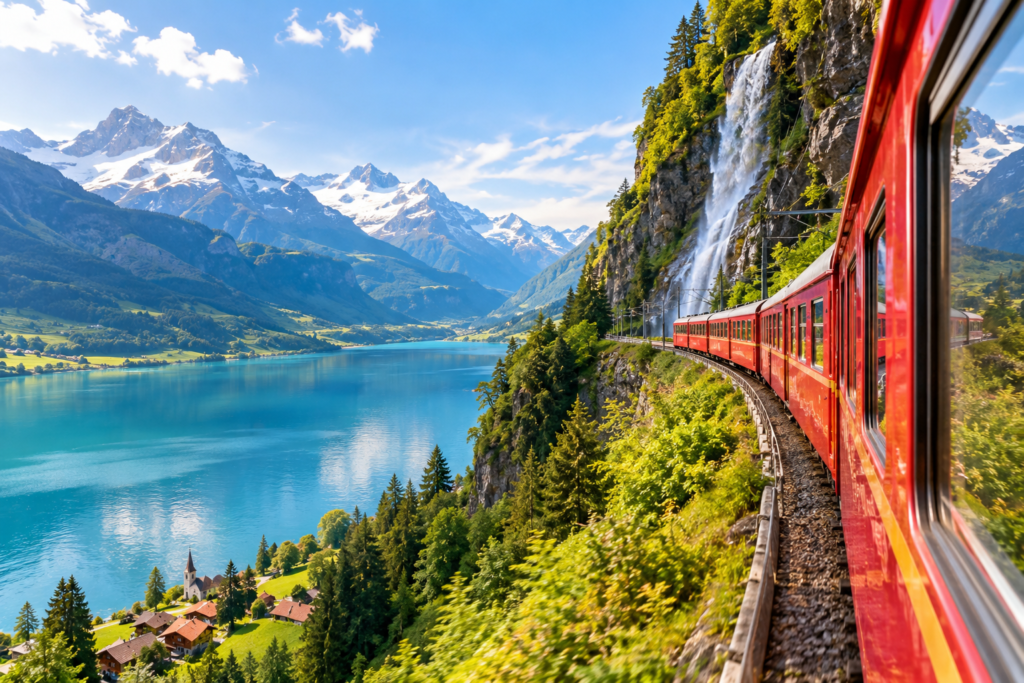

There is something uniquely memorable about seeing a destination through a train window. Instead of moving quickly between airports and highways, travelers can watch landscapes gradually change from busy cities to quiet villages, green valleys, dramatic mountains, coastlines, and wide open countryside. A scenic train journey can turn transportation itself into one of the most enjoyable parts of a vacation, especially for travelers who want to experience a destination at a slower pace.
Scenic rail travel also offers a different perspective from ordinary sightseeing. You are not simply trying to reach the next destination; the landscape between two places becomes part of the experience. Depending on the route, you might cross historic bridges, follow a mountain valley, travel beside a lake, pass through forests, or watch the countryside change outside your window. For travelers planning an unforgettable journey, these rail routes can be attractions in their own right.
Why Scenic Train Travel Is Different
A scenic train journey allows travelers to experience large areas without spending hours behind the wheel. You can sit comfortably, enjoy a meal, read a book, take photographs, or simply watch the landscape. This makes rail travel particularly attractive to people who want sightseeing to feel relaxing rather than exhausting.
There is also something special about the changing scenery. A flight can take you from one region to another in a few hours, but a train allows you to watch the transition happen gradually. Mountains appear on the horizon, villages become visible along the tracks, rivers follow the route, and eventually the landscape changes completely. The journey becomes a story rather than a simple transfer.
What Makes a Train Journey Truly Scenic?
Not every long-distance train route provides the same visual experience. Some are designed primarily for efficient transportation, while others pass through landscapes that become major attractions themselves. Before booking, travelers should consider the route, season, duration, seating arrangement, and whether there are opportunities to stop along the way.
Mountain scenery: Routes through highlands and valleys can provide dramatic views of peaks, forests, and winding rivers.
Coastal landscapes: Trains traveling beside the ocean can offer constantly changing views of beaches, cliffs, harbors, and coastal towns.
Historic routes: Older rail lines may pass through traditional communities, bridges, tunnels, and landscapes that have long been associated with railway travel.
Changing environments: Some journeys are especially memorable because they cross several different types of terrain during one trip.
Comfortable viewing: Large windows and suitable seating can make a major difference when the scenery is the main reason for taking the journey.
The best route depends on what you personally want to see. A traveler who loves mountains may prefer an Alpine journey, while someone interested in coastal scenery may enjoy a route beside the sea. Choosing based on the landscape rather than simply the train’s reputation can lead to a more satisfying experience.
The Glacier Express, Switzerland
Switzerland is famous for its mountain railways, and the Glacier Express is one of the journeys that has become closely associated with scenic train travel. The route crosses dramatic Alpine landscapes and connects destinations in the Swiss mountains, offering views of valleys, villages, bridges, and rugged terrain.
The journey is not simply about reaching the final destination. The changing landscape outside the window provides much of the experience. Travelers can watch the scenery transform as the train moves through different elevations and regions, making the route especially appealing to photographers and anyone who enjoys mountain environments.
The Bernina Express, Switzerland and Italy
The Bernina Express offers another memorable Alpine railway experience, with a route that connects Switzerland and Italy. The journey is known for mountain scenery, valleys, lakes, bridges, and dramatic changes in elevation. Its international character also adds variety because the landscape and atmosphere change as the route progresses.
Travelers who enjoy photography should pay attention to weather and season when planning this journey. Clear skies can reveal distant peaks, while changing weather can create a completely different atmosphere. Rather than focusing on getting the perfect photograph of every moment, it is worth simply watching the landscape develop throughout the trip.
The Rocky Mountaineer, Canada
Canada’s Rocky Mountains provide one of the world’s most recognizable landscapes for scenic rail travel. Routes associated with the Rocky Mountaineer pass through mountain scenery, forests, rivers, and valleys, creating long stretches where the landscape itself becomes the main attraction.
The experience is particularly appealing to travelers who want to appreciate the Canadian wilderness without driving long distances themselves. Depending on the route and travel package, passengers can experience a combination of rail travel and overnight stays, turning the journey into a larger vacation rather than a simple train ride.
The West Highland Line, Scotland
Scotland’s West Highland Line provides a very different atmosphere from the dramatic Alpine routes of Switzerland and Canada. The journey passes through rugged landscapes, lochs, moorland, mountains, and remote countryside. Its scenery can feel especially atmospheric when clouds and changing weather move across the landscape.
This route can appeal to travelers interested in combining rail travel with Scottish history and outdoor exploration. Depending on the itinerary, passengers can use the train journey as part of a larger trip through the Highlands rather than treating it as an isolated activity.
The Flam Railway, Norway
Norway’s Flam Railway is known for its dramatic mountain environment and steep railway journey. The route connects the mountain region around Myrdal with Flåm and provides views of waterfalls, valleys, steep slopes, and surrounding scenery.
The relatively short journey makes it useful for travelers who want a scenic railway experience without committing to an entire day or overnight train. It can also fit naturally into a larger Norway itinerary that includes fjords, villages, and outdoor activities.
The TranzAlpine, New Zealand
New Zealand’s South Island offers spectacular natural scenery, and the TranzAlpine journey crosses the South Island between Christchurch and the west coast. The route moves through changing landscapes that include plains, mountains, valleys, and other striking natural environments.
The journey demonstrates why scenic rail travel can be valuable even in a country where renting a car is popular. Travelers can sit back and experience the landscape without focusing on driving. This creates more opportunities to photograph the scenery and simply enjoy the journey.
The California Zephyr, United States
The California Zephyr provides a long-distance American rail experience that crosses a variety of landscapes. The route travels between Chicago and the San Francisco Bay Area, passing through sections of the country with dramatically different scenery.
Because it is a long journey, travelers should think about the experience differently from a short sightseeing train. The changing landscape becomes part of a broader cross-country adventure. It can be particularly interesting for travelers who want to see how American geography changes across multiple regions without having to drive the entire distance.
The West Coast Main Line and Scottish Connections, United Kingdom
Rail travel in the United Kingdom offers numerous opportunities to combine historic cities with countryside views. Routes connecting major English and Scottish destinations can pass through rolling landscapes, rural communities, rivers, and mountainous areas farther north.
For travelers who want flexibility, the UK rail network can also make it easier to combine several destinations. Instead of booking a dedicated scenic-tour train, you can build your own itinerary around regular rail services and spend time exploring cities and countryside along the way.
How to Choose the Right Scenic Train Journey
Choosing a scenic train is easier when you first decide what type of landscape interests you most. A route through mountains will provide a completely different experience from one beside the ocean or through open countryside. Think about whether you prefer dramatic scenery, historic towns, wildlife, or a mixture of environments.
- Choose the landscape first: Decide whether mountains, coastlines, forests, valleys, or countryside are most appealing.
- Check the journey length: A short scenic route may work better within a busy itinerary, while a longer route can become the main feature of the trip.
- Research the season: Snow, autumn foliage, spring greenery, and summer daylight can dramatically change the scenery.
- Compare seating options: Window placement and carriage design can influence how much you see.
- Check the route direction: Some routes can look different depending on which side of the train you sit on.
- Look at stopover opportunities: A route becomes even more interesting when you can spend time in towns along the way.
The right choice is not necessarily the most famous train journey. A route that matches your interests, schedule, and budget can provide a more satisfying experience. It is also worth checking whether the train operates year-round because some scenic services change schedules according to season.
What to Pack for a Scenic Train Journey
Packing for rail travel is generally easier than preparing for a long road trip because you do not need to carry your belongings constantly. Still, a few carefully chosen items can make several hours on a train more comfortable.
Comfortable clothing: Wear layers so you can adjust to changing temperatures inside and outside the train.
Camera or smartphone: Scenic journeys naturally create opportunities for photography, but remember to enjoy the view without spending the entire journey behind a screen.
Headphones: Useful if you want to listen to music or an audiobook during quieter portions of the journey.
Water and snacks: Check the train’s food policy and onboard services before deciding what to bring.
Portable charger: Long journeys can use considerable phone battery, particularly when taking photographs or using travel apps.
Small day bag: Keep important items nearby instead of repeatedly opening your main luggage.
A lightweight approach is especially useful when your train journey includes connections. Keep your essentials accessible so you do not need to unpack your larger luggage during every stop.
How to Get the Best Views From the Train
The quality of the view can depend on seating, weather, and the direction of travel. If reservations are available, investigate the route before choosing your seat. Some trains have panoramic windows, observation areas, or specially designed carriages that make scenic viewing easier.
Do not assume that every great view will appear on one side of the train. Landscapes change constantly, and a route that looks spectacular in one direction may offer equally interesting scenery later. If the train has an observation area or allows passengers to move between carriages, take advantage of it when permitted.
When Is the Best Season for a Scenic Train Journey?
Season can completely transform a rail journey. Summer may provide long daylight hours and clear access to mountain routes, while autumn can add dramatic foliage to forested landscapes. Winter can turn mountain scenery into a snow-covered environment, although some routes may operate differently during colder months.
Spring can offer another type of beauty, especially when valleys become green and flowers appear. Before booking, check the specific route’s operating schedule and expected conditions. Scenic transportation is often most enjoyable when the season matches the landscape you hope to see.
How to Turn a Train Journey Into a Complete Vacation
A scenic train does not have to be a standalone activity. You can build a larger trip around it by spending a few nights at the beginning and end of the route. This allows you to explore local communities rather than seeing them only through the train window.
For example, travelers can arrive in one city, spend several days exploring, take the scenic train to another region, and then continue the vacation from there. This approach creates a natural rhythm of city exploration, slow travel, and outdoor scenery without requiring constant flights.
Mistakes to Avoid on a Scenic Train Journey
1. Choosing a route only because it is famous: Popularity does not guarantee that the scenery matches your personal interests.
2. Ignoring the weather: Mountain and coastal conditions can change quickly, affecting visibility.
3. Booking without checking the schedule: Some scenic services have limited operating days or seasonal changes.
4. Bringing too much luggage: Large bags can become inconvenient when changing trains or moving between stations.
5. Spending the whole journey on your phone: Photos are wonderful, but the scenery itself is the reason you made the trip.
6. Forgetting stopovers: A town along the route may be worth exploring instead of simply passing through.
Planning carefully helps you avoid turning a scenic journey into a logistical challenge. The best rail trips feel comfortable from beginning to end, with enough time to enjoy the landscape rather than constantly worrying about the next connection.
Five Questions Travelers Often Ask
1. Are scenic train journeys suitable for families?
Many scenic routes can work well for families because passengers can move around more freely than in a car and enjoy changing scenery without needing to drive. However, journey length, onboard facilities, and children’s needs should be considered before booking.
2. How far in advance should I book a scenic train?
Popular routes can have limited seating, particularly during peak travel periods. Booking earlier gives travelers more choice regarding dates, departure times, and seating arrangements.
3. Are scenic train journeys expensive?
Prices vary significantly depending on the route, class of service, duration, and included facilities. Some regular rail services provide beautiful scenery at ordinary ticket prices, while premium scenic services can cost substantially more.
4. Should I take photographs throughout the journey?
Photography can be one of the highlights, but it is worth balancing photographs with simply watching the landscape. Clean windows, changing weather, reflections, and moving scenery can make photography challenging, so patience helps.
5. Is a scenic train better than renting a car?
Neither option is automatically better. A train allows travelers to relax and focus on scenery, while a car provides greater flexibility for remote areas and spontaneous stops. The best choice depends on the destination and the type of trip you want.
Conclusion
Scenic train journeys offer a special way to experience the world because the journey itself becomes part of the destination. From Switzerland’s Alpine landscapes and Canada’s mountain scenery to Scotland’s rugged countryside and New Zealand’s dramatic South Island, these routes allow travelers to experience changing landscapes without the pressure of driving or rushing through airports.
The most rewarding rail adventure is the one that matches your travel style. Choose a route based on the scenery you genuinely want to see, research the best season, organize your seating and luggage carefully, and leave enough time to enjoy the journey itself. Sometimes the most unforgettable part of a vacation is not the place where the train finally stops, but everything you see between departure and arrival.