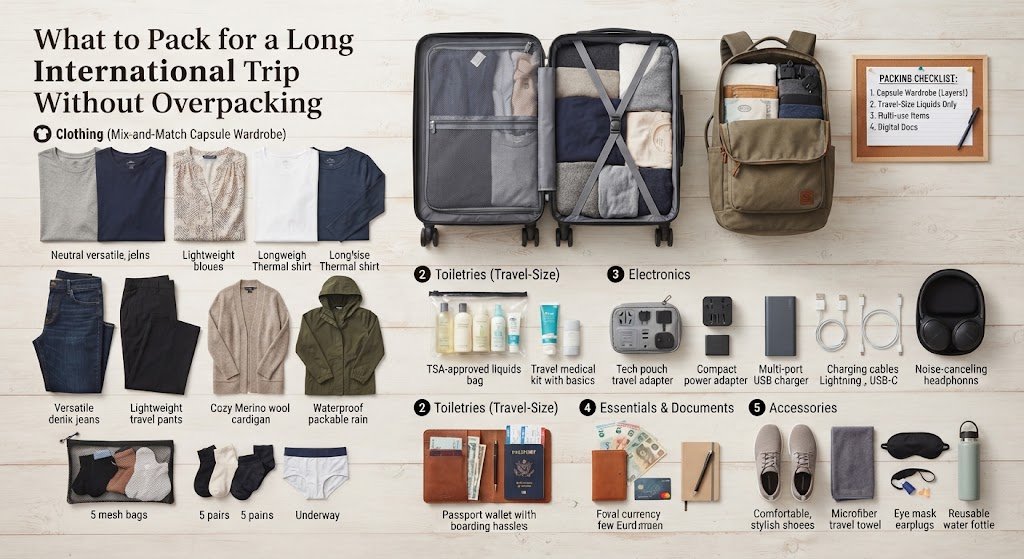

Packing for a long international trip can become complicated surprisingly quickly. When you know you will be away from home for several weeks, it is tempting to prepare for every possible situation by adding extra clothes, shoes, toiletries, electronics, and miscellaneous items to your suitcase. The problem is that a suitcase filled with “just in case” items can become difficult to carry, expensive to check, and frustrating to manage once you start moving between hotels, airports, trains, and different destinations.
The key to packing light is not taking less care with your preparation. It is choosing items that can perform more than one purpose and building your luggage around the actual conditions of your trip. A long journey does not necessarily require a huge suitcase. With versatile clothing, practical footwear, organized toiletries, useful technology, and a simple laundry strategy, you can travel for weeks without carrying everything you own.
Start With Your Trip, Not Your Suitcase
Before putting anything into your luggage, look at your actual itinerary. The number of days you will be away is important, but the destinations, weather, accommodation, transportation, and planned activities are even more important. A three-week trip through warm cities requires a completely different packing strategy from a three-week journey involving mountains, beaches, formal events, and cold weather.
Write down the major conditions you expect to encounter. Consider whether you will be walking extensively, changing hotels frequently, attending special events, visiting beaches, hiking, or spending time in places where conservative clothing is appropriate. This prevents you from packing random items simply because you are worried that you might eventually need them.
Build a Small Travel Wardrobe
The easiest way to reduce luggage is to create a wardrobe where most pieces work together. Instead of packing individual outfits for every day, select clothing that can be combined in different ways.
Choose a few neutral or easily matching colors and focus on pieces that can be worn in multiple situations. A comfortable shirt might work for sightseeing during the day and a casual dinner in the evening. Lightweight trousers can work with several different tops, while a simple jacket can change the appearance of an otherwise basic outfit.
The goal is not to make every day look completely different. The goal is to have enough variety while avoiding unnecessary duplication.
Follow the Laundry Strategy
One of the biggest misconceptions about long trips is that you need enough clothing for the entire journey. You usually do not. Laundry can dramatically reduce the amount of clothing you need to carry.
If you are traveling for two or three weeks, plan to wash clothes during the trip rather than packing several weeks’ worth of outfits. Depending on your accommodation, you might use a hotel laundry service, a local laundromat, or a washing machine at an apartment or guesthouse.
Even a small amount of laundry can extend the usefulness of your travel wardrobe. Instead of carrying fifteen or twenty shirts, you may only need a smaller collection that can be washed and reused.
Pack Clothing in Layers
Layers are especially useful when an international trip crosses different climates. Instead of packing a separate heavy outfit for every temperature, use several lighter pieces that can be combined.
A lightweight base layer, long-sleeve shirt, sweater, and compact outer layer can provide several combinations. If the weather becomes warmer, you can remove layers without carrying completely different clothing.
This strategy is particularly useful when visiting destinations where mornings and evenings are cooler than the middle of the day. It also gives you more flexibility when weather conditions change unexpectedly.
Choose Shoes Carefully
Shoes are among the heaviest and most space-consuming items in luggage, so they deserve special attention. Many travelers make the mistake of packing several pairs for different outfits when two versatile pairs would be enough.
Your primary pair should be comfortable enough for extensive walking. If your trip includes formal dinners or special events, a second pair may be useful. For beach destinations, lightweight sandals or similar footwear can sometimes replace bulkier alternatives.
Avoid packing shoes simply because they look good with one particular outfit. If a pair has only one purpose and takes significant space, it may not justify carrying it across multiple countries.
Use the Shoes You Wear While Traveling
Whenever practical, wear your heaviest shoes during the journey rather than placing them inside your suitcase. This can create additional space for clothing and other items.
The same principle applies to bulky jackets or heavier layers. If you need them for the climate at your destination, wearing them during transportation can reduce the weight and volume inside your luggage.
However, comfort should come first. Do not wear extremely heavy or uncomfortable clothing simply to save a small amount of suitcase space.
Create a Toiletry System
Toiletries can quietly consume a large amount of luggage space. Full-size bottles of shampoo, conditioner, body wash, lotion, and other products may not be necessary, especially when you are staying in hotels or visiting cities with easy access to stores.
Use appropriately sized travel containers for products you genuinely need. Keep the toiletry collection focused on essentials rather than bringing every product you use at home.
Daily essentials: Pack the personal-care items you use consistently.
Small quantities: Bring enough for the journey or plan to purchase more after arrival.
Leak protection: Place liquids in secure containers and use a separate pouch to protect clothing from accidental spills.
A simple toiletry system is easier to organize and much easier to replace if something is lost.
Pack Important Documents Separately
Your passport, travel documents, identification, reservations, and other essential paperwork should not be buried at the bottom of your main suitcase. Keep important documents somewhere secure and easily accessible.
Make digital copies of important information and store them securely so you can access them if an original document is misplaced. It is also useful to keep important accommodation addresses and transportation details available offline.
Your document organization should allow you to find what you need quickly without unpacking your entire bag at an airport or hotel reception desk.
Think Carefully About Electronics
Modern travelers often carry several electronic devices, but not all of them are necessary. A phone can replace a camera, map, music player, boarding-pass holder, and communication device for many travelers.
Before packing each device, ask yourself whether it provides a meaningful benefit during the trip. If you are bringing a laptop, tablet, camera, smartwatch, headphones, chargers, and other accessories, the combined weight can become significant.
Create one organized electronics pouch instead of placing cables and chargers throughout your luggage. This makes it much easier to find what you need and prevents small accessories from disappearing between clothing.
Don’t Forget Travel Adapters
Electrical standards differ between countries, so international travelers should check the plug and voltage requirements of their destinations before leaving.
A compact universal travel adapter can be useful when visiting multiple countries, particularly when your itinerary crosses different electrical systems. However, make sure the adapter you choose is appropriate for your devices and destination.
Do not assume that an adapter automatically changes voltage. Adapters and voltage converters serve different purposes, and travelers should understand the requirements of their specific electronics.
Pack a Small Personal Bag
Your main suitcase should not contain everything you need during the journey. A smaller personal bag can hold items you want to access during flights, train rides, and other transportation.
Keep essentials such as identification, phone, charging cable, headphones, medications, a small amount of personal care products, and important travel information in this bag.
This arrangement also provides some protection if your checked luggage is delayed. You will still have several essential items with you while the luggage issue is resolved.
Keep Essential Medication Accessible
If you take regular medication, keep it properly organized and accessible during travel. Avoid placing all essential medication in checked luggage because checked bags can sometimes be delayed.
Bring the medication in its appropriate packaging and carry any relevant documentation that may be useful during international travel. If you need a particular medication throughout the trip, make sure you have enough for the journey rather than assuming it will be immediately available at your destination.
A small health pouch can also hold basic personal-care items, but avoid turning it into a full medical cabinet.
Use Packing Cubes Wisely
Packing cubes can make luggage easier to organize, particularly during long trips with multiple hotel changes. You can separate clothing, underwear, accessories, and other categories so that you do not have to empty the entire suitcase every time you need something.
However, packing cubes do not actually reduce the weight of your belongings. They organize space rather than magically creating additional luggage capacity.
Use them as an organizational tool, not as a reason to pack more. If a cube is empty, you do not need to fill it simply because there is available space.
Keep a Small Laundry Kit
A basic laundry strategy can make a long trip significantly easier. Depending on your preferences and destination, you may carry a small amount of detergent designed for travel or use laundry facilities along the way.
Some travelers also carry a compact reusable bag for separating clean and dirty clothing. This prevents worn clothes from mixing with freshly washed items.
The important thing is to plan for laundry before you start packing. Once you accept that clothes can be washed and reused, there is much less temptation to pack a separate outfit for every day.
Avoid the “Just in Case” Trap
The phrase “just in case” is responsible for a huge amount of unnecessary luggage. Travelers often pack items because they might need them, even when there is little evidence that they actually will.
Before packing something, ask three questions: How likely am I to use this? Can I buy or borrow it at my destination? Does another item already serve the same purpose?
If the answer suggests that the item is unlikely to be useful, leave it at home. This simple test can remove several kilograms of unnecessary belongings.
Think About Your Destination’s Shopping Options
You do not need to bring every consumable item for an entire international trip. Major cities and tourist destinations generally have stores, pharmacies, supermarkets, and other places where travelers can purchase basic necessities.
This means you can often pack smaller quantities of toiletries, snacks, and other consumables. Once you arrive, you can purchase additional supplies when necessary.
Of course, this strategy should be adjusted for remote destinations where shopping opportunities may be limited. Research your itinerary rather than assuming every location will have the same access to basic supplies.
Prepare for Different Activities
Long international trips often include several different types of activities. You might visit museums one day, hike the next, eat at a restaurant that evening, and spend the following day at the beach.
Rather than packing separate outfits for each activity, choose versatile pieces that can adapt. Lightweight athletic clothing may work for walking and casual sightseeing, while a simple outfit can cover restaurants and everyday city exploration.
If your itinerary includes one genuinely formal event, bring one suitable outfit rather than several. This keeps your wardrobe practical while still preparing you for important occasions.
Leave Some Space in Your Suitcase
One of the best packing decisions is to avoid filling your suitcase completely before leaving home. International travel often leads to souvenirs, local products, gifts, or clothing purchases.
If your luggage has no free space, you may have to rearrange everything at the end of the trip or purchase an additional bag. Leaving some room gives you flexibility.
A half-empty suitcase is not a sign that you packed badly. It can mean that you packed efficiently and left yourself options.
Weigh Your Luggage Before Leaving
Airline baggage restrictions can vary, and excess baggage fees can become expensive. Weigh your suitcase before leaving home rather than discovering the problem at the airport.
If the bag is heavier than expected, remove the least useful items first. Look for duplicate clothing, unnecessary shoes, oversized toiletries, excessive electronics, and items that can easily be purchased at the destination.
This final check can save both money and stress.
What Not to Pack
Some items appear useful at home but become unnecessary when traveling internationally. Large collections of toiletries, multiple pairs of similar shoes, excessive casual clothing, bulky towels, duplicate electronics, and too many accessories can quickly consume your available space.
Avoid packing things simply because they make you feel prepared. Preparation is about having the right items, not the greatest number of items.
If an item is inexpensive, widely available, and unlikely to be used regularly, consider purchasing it only if you actually need it after arrival.
A Practical Long-Trip Packing List
Clothing: Several versatile tops, comfortable bottoms, underwear, socks, sleepwear, one warmer layer, and weather-appropriate outerwear.
Footwear: One primary walking pair and one additional pair only if your itinerary genuinely requires it.
Toiletries: Essential personal-care products in travel-friendly quantities.
Technology: Phone, necessary chargers, appropriate adapter, and only the additional devices you genuinely expect to use.
Documents: Passport, required travel documents, reservations, insurance information if applicable, and secure digital copies.
Health items: Regular medication and a small selection of genuinely useful personal-care supplies.
Accessories: Sunglasses, compact bag, reusable water bottle, and other items that serve a clear purpose.
This list should be adapted to the destination, season, and activities. There is no universal suitcase that works perfectly for every international journey.
A Simple Final Packing Test
Once everything is packed, remove about five items that you are least confident you will use. Look at the remaining luggage and ask whether every category is represented without unnecessary duplicates.
Then check your itinerary one more time. If the trip includes cold weather, make sure you have appropriate layers. If it includes beaches, make sure you have suitable clothing. If it involves extensive walking, prioritize comfortable footwear.
The final goal is not to achieve the smallest suitcase possible. It is to create luggage that contains what you genuinely need while remaining comfortable enough to carry throughout the trip.
Frequently Asked Questions
1. How many clothes should I pack for a long international trip?
The exact number depends on the destination, weather, activities, and laundry access. Instead of packing for every day, create a smaller wardrobe that can be washed and reused throughout the trip.
2. Is it better to use a backpack or suitcase for international travel?
Both can work well. A suitcase may be convenient for organized hotel stays, while a backpack can be useful when frequently changing locations or using stairs and public transportation. Your itinerary should determine the better option.
3. How can I reduce suitcase weight quickly?
Start by removing duplicate clothing, extra shoes, oversized toiletries, unnecessary electronics, and “just in case” items. Weigh the bag afterward and continue removing anything that does not have a clear purpose.
4. Should I pack for the entire length of a three-week trip?
Usually, no. Planning to do laundry during the trip can significantly reduce the amount of clothing required. A versatile wardrobe can be reused several times.
5. What is the most important thing to remember when packing light?
Pack according to your actual itinerary rather than imaginary situations. Choose versatile items, avoid unnecessary duplicates, and remember that many basic necessities can be purchased at your destination.
Conclusion
Packing for a long international trip without overpacking is mainly a matter of planning rather than sacrifice. You do not need to own specialized travel equipment or reduce your belongings to an extreme minimum. Instead, build a versatile wardrobe, plan for laundry, limit footwear, organize toiletries, keep important documents accessible, and bring only the electronics and accessories that genuinely support your journey.
A lighter suitcase can make almost every part of international travel easier. Moving between airports, trains, hotels, and different cities becomes less tiring, while unpacking and repacking take less time. Most importantly, packing efficiently leaves you with more freedom to enjoy the trip instead of constantly managing your belongings. The best suitcase is not the one filled to its maximum capacity; it is the one that contains everything you need and very little that you do not.